Clinical Breakthrough at ASH 2025: CLN-049 Demonstrates 50% Response Rate in TP53-Mutated AML via Novel FLT3xCD3 Engagement

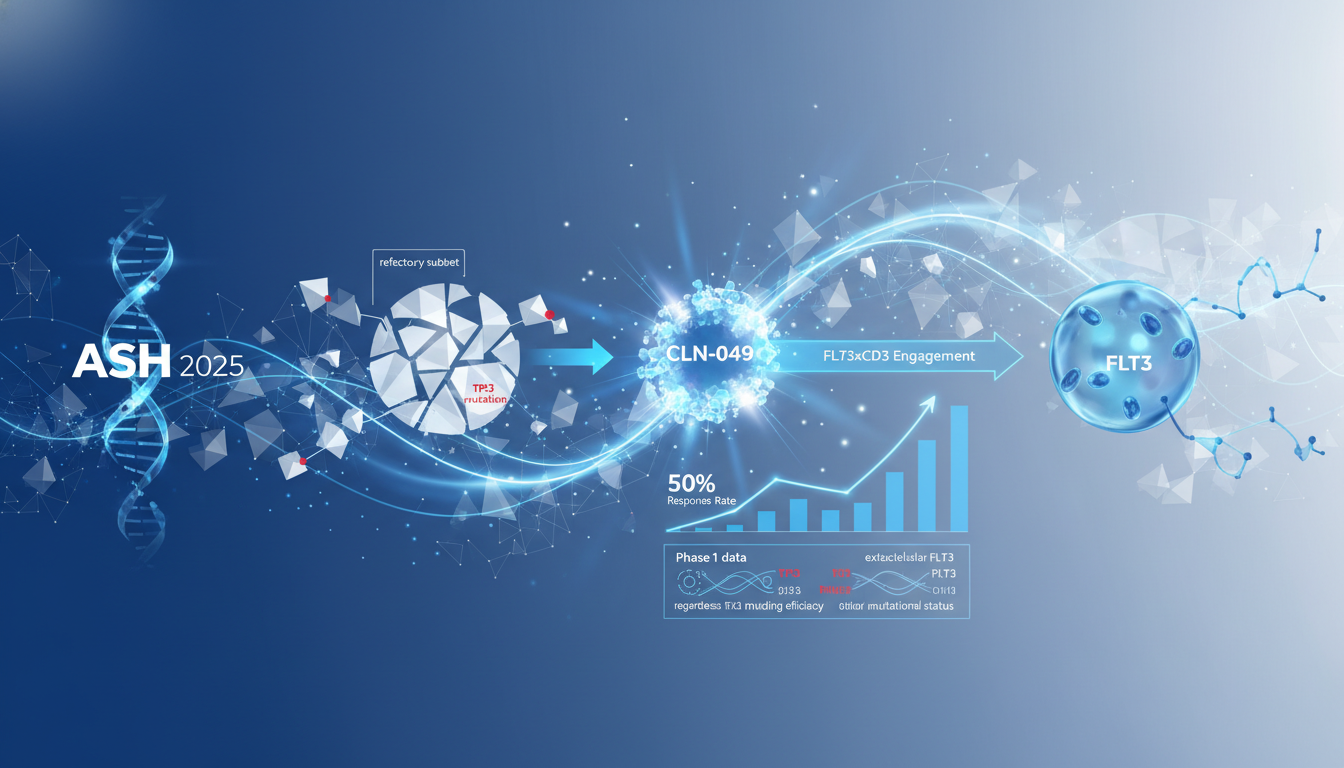
Phase 1 data confirms extracellular FLT3 binding efficacy regardless of mutational status, offering a potential breakthrough for refractory subsets.
- These analyses reflect my personal opinions and may include input from multiple sources. They are for informational purposes only and do not constitute professional advice. *
Clinical Perspective
Data presented today at the 67th American Society of Hematology (ASH) Annual Meeting highlights a significant advancement in the treatment of relapsed/refractory (R/R) Acute Myeloid Leukemia (AML). Cullinan Therapeutics ($CGEM) presented oral findings for CLN-049, a bispecific T-cell engager (TCE) targeting FLT3xCD3.
Mechanism of Action & Differentiation
Unlike tyrosine kinase inhibitors (TKIs) that target intracellular kinase domains and are often limited by specific mutations (ITD/TKD) or resistance mechanisms, CLN-049 binds to the extracellular domain of FLT3. This allows for T-cell redirection against leukemic blasts regardless of FLT3 mutational status or expression level.
Key Efficacy Data (Cutoff: Aug 2025)
In a heavily pre-treated cohort (median 2 prior lines):
- Overall Efficacy: At the highest target dose (12 µg/kg), the CR/CRh rate was 31% (5/16).
- High-Risk Subsets: Notably, in patients with TP53 mutations—a historically dismal prognostic group—CLN-049 achieved a 50% CR/CRh rate (4/8 patients).
- Durability: The majority of responses exceeded 16 weeks, with confirmed MRD negativity in multiple responders bridging to transplant.
Safety Profile
The safety profile appears manageable in an inpatient setting. While Cytokine Release Syndrome (CRS) was common (35.6%), it was effectively mitigated via step-up dosing. Crucially, no Grade 3 CRS occurred in the double step-up regimen, preserving the therapeutic window.
Clinical Implications
The FDA Fast Track designation underscores the urgency here. For hematologists, CLN-049 represents a viable salvage therapy for patients failing Venetoclax/HMA or prior FLT3 inhibitors, particularly those with complex karyotypes or TP53 mutations lacking targeted options.
Strategic Analysis
The Good:
The efficacy signal is undeniable. A 31% CR/CRh rate in relapsed/refractory patients is competitive with approved therapies. More importantly, the ability to treat TP53-mutated patients (50% response rate) and achieve Measurable Residual Disease (MRD) negativity suggests CLN-049 offers deep, quality responses that can bridge patients to curative transplants.
The Challenge:
While efficacy is strong, the administration profile is complex compared to oral competitors like Gilteritinib. CLN-049 requires intravenous step-up dosing to manage Cytokine Release Syndrome (CRS). While safety data was favorable (no Grade 3 CRS with optimized dosing), the logistical burden of inpatient monitoring may impact community oncology uptake unless future regimens allow for outpatient delivery.
The Path Forward:
With FDA Fast Track designation secured, Cullinan is moving to expansion cohorts in 2026. The strategic question remains: Will Cullinan take this to commercialization alone, or will an established player like Astellas or AbbVie acquire the asset to fortify their hematology dominance? The data supports a strong 'bolt-on' acquisition case.
Investment Thesis
Cullinan Therapeutics ($CGEM) has delivered a material de-risking event for CLN-049. The Phase 1 data presented at ASH 2025 validates the bispecific antibody approach in Acute Myeloid Leukemia (AML), unlocking a commercial opportunity estimated at >$1 billion in the relapsed/refractory (R/R) setting alone.
Valuation Drivers
- Competitive Moat: Efficacy in TP53-mutated AML (50% CR/CRh) creates a high-value niche where competitors struggle.
- Market Expansion: Unlike Menin inhibitors or mutation-specific TKIs, CLN-049 targets >80% of AML cases (FLT3 agnostic).
- Regulatory Speed: FDA Fast Track designation accelerates the path to a pivotal Phase 2 study.
M&A Landscape
The strategic fit for CLN-049 is high. With big pharma facing patent cliffs, an asset that works in TKI-refractory patients is a prime "bolt-on" candidate.
- Potential Suitors: Astellas ($ALPMY) holds a dominant FLT3 position with Xospata and needs next-gen assets to defend the franchise. AbbVie ($ABBV) requires pipeline depth beyond Venetoclax. Amgen ($AMGN) has TCE expertise.
Financial Runway
$CGEM has the runway (into 2029) to negotiate from strength, reducing dilution risk while advancing to expansion cohorts in 2026.
These analyses reflect my personal opinions and may include input from multiple sources. They are for informational purposes only and do not constitute professional advice.
Copyright © 2025 ClinRM, LLC. Content is shared for non‑commercial use only. No reproduction, distribution, or reliance for commercial purposes is permitted.