Soquelitinib (CPI-818) Phase 1b: ITK Inhibition Delivers JAK-Like Efficacy Without Class-Wide Toxicity

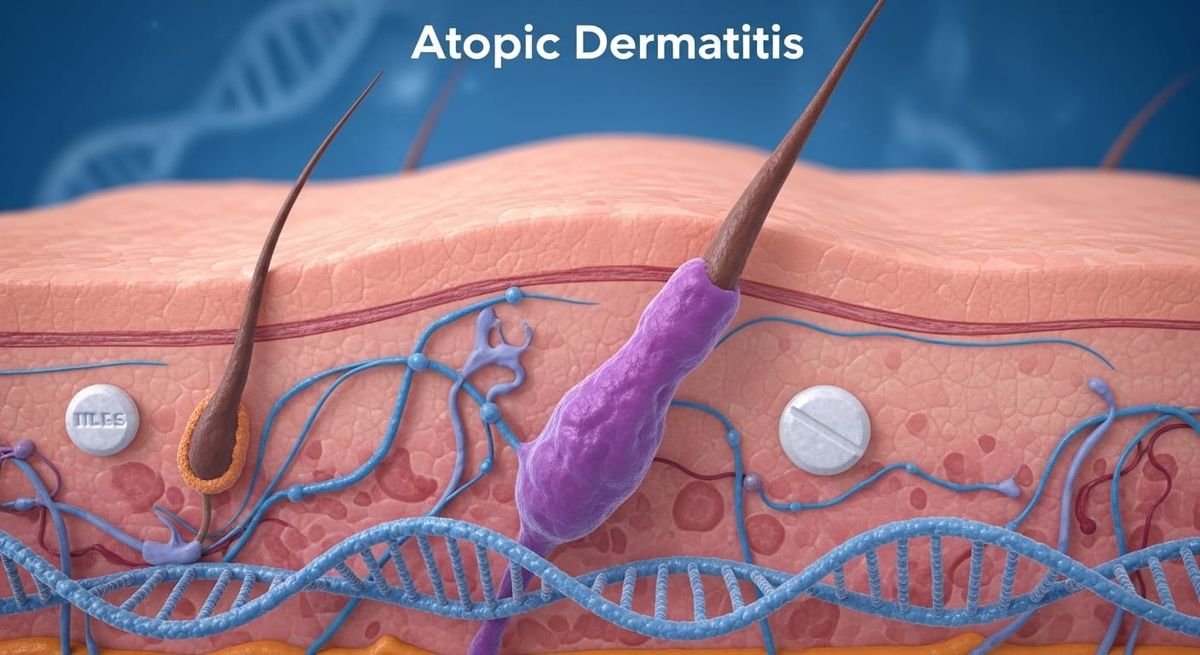
Phase 1b data reveals a 75% EASI-75 response at Week 8, suggesting a potential disruption of the JAK/Biologic dichotomy through selective T-cell modulation.
See Disclaimer below *
Despite the commercial success of Dupilumab ($REGN Dupixent), the Atopic Dermatitis (AD) landscape remains characterized by a significant "ceiling of efficacy" and a "floor of safety." Approximately 50-60% of patients on Dupilumab do not achieve clear skin (IGA 0/1), creating a massive reservoir of partially responsive or refractory patients.
Furthermore, the current oral alternatives—JAK inhibitors like Upadacitinib ($ABBV Rinvoq)—are constrained by Black Box warnings for malignancy and cardiovascular events. This leaves a critical gap in the epidemiology: a need for an oral therapy with biologic-like safety and JAK-like efficacy. Soquelitinib (CPI-818) has now demonstrated the clinical profile to fill this void.
Rapid Efficacy Parity with High-Dose JAK Inhibitors
The most clinically significant finding from the Phase 1b (Cohort 4) data is the rapidity of response. Soquelitinib (200 mg BID) achieved an EASI-75 of 75% at Week 8.
- Competitive Benchmark: This response rate is statistically comparable to Upadacitinib ($ABBV Rinvoq) 30mg, which historically demonstrates ~70-80% EASI-75 at Week 16 but carries a Black Box warning.
- Superiority vs. SOC: The onset of action appears faster than Dupilumab ($REGN Dupixent), which typically requires 16 weeks to reach maximal efficacy plateaus in similar demographics.
- Clearance Metrics: The 33% IGA 0/1 (Clear/Almost Clear) achievement at Week 8 suggests high potency, critical for patients with high body surface area (BSA) involvement who fail topical management.
The Th1/Th17/Treg Triad Advantage
Unlike JAK inhibitors that broadly suppress cytokine signaling (often leading to infection risks and cytopenias), Soquelitinib functions as a selective ITK inhibitor. This distinct mechanism addresses the complex immunopathology of Atopic Dermatitis (AD) through three vectors:
- Th2 Blockade: Direct inhibition of IL-4/IL-13 signaling, matching the efficacy driver of biologic SOC.
- Th17 Suppression: Crucial for the "Asian Phenotype" and intrinsic AD subtypes (psoriasis-like features) where pure Th2 blockers (Dupilumab/Tralokinumab) show reduced efficacy.
- Treg Expansion: The induction of T-regulatory cells offers the theoretical potential for immune rebalancing and durable remission, distinct from the "rebound effect" often seen upon cessation of JAK inhibitors like Abrocitinib ($PFE Cibinqo).
Establishing the "Clean Oral" Standard
The primary barrier to oral adoption in AD has been safety. Phase 1b data positions Soquelitinib as the solution to the "Efficacy-Safety Trade-off":
- Cardiovascular & Malignancy: No MACE, thrombosis, or malignancy signals were observed, differentiating the asset from the JAK class (Upadacitinib, Abrocitinib, Baricitinib).
- No Monitoring Burden: Unlike JAKs requiring lipid and CPK monitoring, or Cyclosporine requiring renal monitoring, Soquelitinib's profile supports a "prescribe and go" model.
- Ocular Safety: Complete absence of conjunctivitis signals, a key differentiator against Dupilumab (up to 30% incidence in some trials) and Tralokinumab.
Differentiation in Refractory Populations
The asset demonstrated up to -96% EASI reduction in patients refractory to prior biologic and JAK inhibitor therapy. This confirms utility in the "Multi-Failure" phenotype, a rapidly growing demographic estimated at ~40% of the moderate-to-severe market.
- Clinical Implication: This supports a Fast Track Designation application specifically for the biologic-refractory population, minimizing regulatory friction while establishing a foothold in the highest unmet need segment.
Commercial & Market Access
1. The "Rescue" Launch (Phase 1 of Commercialization)
The immediate strategic priority is to target the ~400,000 patients in the US/EU who are refractory to biologics. This high-need segment allows for:
- Premium Pricing: Justified by the "rescue" utility.
- Rapid Adoption: Driven by the lack of viable alternatives for patients ineligible for JAKs.
2. The "Safe Oral" Expansion (Phase 2 of Commercialization)
Upon establishing safety in the rescue population, the asset can move upstream to challenge JAK inhibitors as the Preferred Oral Systemic. The value proposition to payers is clear:
- Cost Offset: Elimination of monitoring costs and management of JAK-associated AEs.
- Intermittent Dosing Model: If durable remission is confirmed, payers will favor a drug that does not require chronic, daily consumption.
3. The Asian Opportunity
Japan represents a Tier 1 strategic priority. The mixed Th2/Th17 phenotype prevalent in Asian populations makes Soquelitinib biologically superior to pure Th2 blockers. A strategic partnership with a Japanese major (e.g., Maruho or Kyowa Kirin) is likely to accelerate this parallel workstream.
Regulatory and Development Risks
- Project Optimus: The FDA's requirement for rigorous dose optimization in oncology/immunology (Project Optimus) mandates a comprehensive Phase 2 design testing multiple doses. While this may extend the timeline to Phase 3, it offer an opportunity to scientifically justify the 200 mg BID regimen and ensure the label is free of class-wide warnings.
- differentiation vs. Pipeline: The rise of OX40 inhibitors (e.g., Amlitelimab) poses a competitive threat regarding dosing frequency. Soquelitinib must lean heavily on its Oral route of administration as a convenience differentiator over injectable OX40s.
Strategic Verdict: Green Light for Phase 2
Soquelitinib has the potential to disrupt both the biologic and small molecule segments of the AD market. The data suggests it is not merely a "me-too" kinase inhibitor, but a novel immunomodulator capable of resetting the disease course.
Disclaimer: ClinicalTrialsDaily.com is owned and operated by ClinRM LLC (“ClinRM”). The views and opinions expressed are solely those of the author(s) and are provided for educational and informational purposes only; they are not medical advice (or a substitute for professional medical judgment) and are not investment, legal, tax, or accounting advice, and nothing on this site is an offer, solicitation, or recommendation to buy or sell any security; information is provided “as is” without warranties of any kind and use is at your own risk—verify critical details with primary sources (e.g., trial registries, publications, and the study team). Full Disclaimer here.
Copyright © 2025 ClinRM, LLC